
 English - United Kingdom
 English - United States
 한국어 - 대한민국

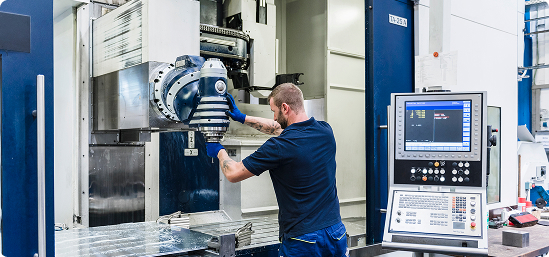
CNC machining leaves very little room for errors. Collisions, programming mistakes, wasted machine time, and inefficient test-cuts can quickly drive up costs and disrupt production.
One of the biggest challenges for any machine shop is machine downtime.
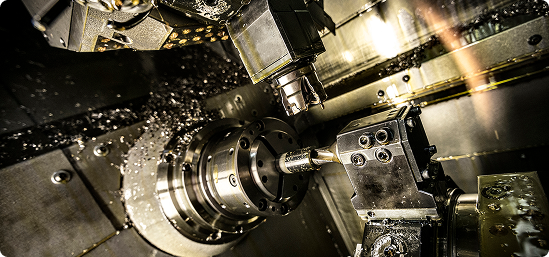
When a machine is not producing parts, productivity and profitability suffer. Machine crashes are especially costly; repairs can run into thousands of dollars, valuable equipment sits idle, and delivery schedules are delayed.
Manual job verification also impacts efficiency. When operators and machines are tied up proving out programs, they are not being used for actual production. Scrap, extra setup time, collisions, and lengthy test-cuts all reduce profitability and make it harder for shops to remain competitive in an industry where uptime is critical.
Solving CNC Machine Inefficiency with the Right Tools
Relying on trial-and-error programming is no longer practical in today’s manufacturing environment. Increasing complex multi-axis machining, tighter tolerances, and raising production costs require manufacturers to adopt smarter and safer workflows.
That’s where CNC machine simulation and verification software comes in.
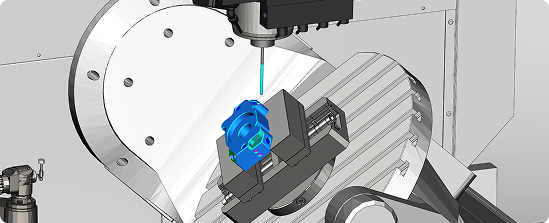
By adding a virtual proving ground to the manufacturing process, engineers and machinists can identify errors before they ever reach the shop floor. Instead of testing programs on expensive machines and risking damage, CNC machine simulation allows validation and optimization to take place digitally, improving productivity, reducing downtime, and protecting valuable equipment.

Benefit of CNC Machine Simulation: Error-free machining
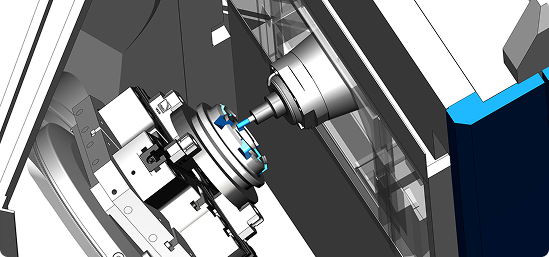
Software-based machine simulation, such as Vericut Verification, acts as a virtual proving ground for your CAD/CAM processes. It enables engineers and machinists to identify errors and prevent collisions before machining begins on the shop floor.
With advanced CNC machine simulation, manufacturers can validate:
- The complete setup and toolpath
- Full machine kinematics and axis travel
- Tool-to-part collisions
- Tool-to-fixture collisions
- Clashes between machine components
Any one of these issues can lead to costly downtime, damaged equipment, or scrapped parts. CNC machine simulation significantly reduces these risks, helping manufacturers eliminate unexpected crashes and near misses.
What makes Vericut different is its ability to verify the actual G-code line by line. Programmers can identify issues directly within the exact code that will run on the CNC machine, without relying on approximations or assumptions.
For complex multi-axis machining operations, this level of precision is critical. Potential problems can be detected and resolved before they cause costly damage or production delays.
The business benefits are clear: reduced downtime, fewer costly mistakes, and the elimination of lengthy manual test-cuts.
Taking Manual Test-Cuts Off the Shop Floor
How much machine time is spent proving out new jobs every year? More importantly, how much production capacity is lost during that process?
With CNC machine simulation, test-cuts move from the shop floor into a digital environment. NC programs can be tested, optimized and validated virtually before they are ever sent to the CNC machine.
Once the program reaches production, operators can run jobs with greater confidence and at full machining speeds.
The result is:
-
Increased machine uptime
-
Shorter lead times
-
Operators focused on higher-value tasks
-
More predictable production schedules
-
Fewer last-minute disruptions and delays
By reducing reliance on physical test-cuts, manufacturers can maximize machine utilization and improve overall shop efficiency.
Benefit of CNC Machine Simulation: Greater Manufacturing Efficiency with Optimization
CNC machine simulation does more than prevent errors, it also creates opportunities for significant production gains, improved tooling performance, and reduced waste.
Vericut Force helps manufacturers move trial-and-error optimization away from your machine and into a digital environment. Force optimization analyzes cut-by-cut of the entire NC program, optimizes the cutting conditions by maximizing chip thickness, adjusting the optimal cutting forces, and feeds and speeds before machining begins.
Using advanced analytics and machine-learning technology, Vericut Force identifies hidden opportunities to improve machining performance and efficiency.
The results can include:
-
Faster cycle times
-
Longer tool life
-
Reduced machine wear
-
Improved material removal rates
-
Lower manufacturing costs.
These benefits are not theoretical. Manufacturers worldwide are achieving measurable improvements in production, machine performance, and profitability through simulation-driven optimization.
Discover real-world customers success story:
Benefit of CNC Machine Simulation: Financial Gains
CNC machine simulation is often viewed as an engineering tool, but its benefits extend far beyond the shop floor. Across the business, simulation delivers measurable financial value.
Reducing machine crashes lowers costly repair expenses and minimizes unplanned downtime. Optimized machining processes help extend tool life, reducing consumable costs and tooling replacement frequency. Even small reductions in cycle times can translate into substantial annual savings when multiplied across production runs.
For finance and operations leaders, CNC machine simulation becomes more than just a verification tool, it is both a risk management solution and a driver of long-term profitability. By improving efficiency, reducing waste, and protecting valuable assets, manufacturers can confidently justify CNC machine simulation software as an advanced manufacturing investment in competitiveness and growth.
Benefit of CNC Machine Simulation: Workforce and Skill Development
CNC machine simulation not only protects equipment and improves profitability, it also empowers the people operating it.
When operators know a program has already been fully verified, they can run jobs with confidence rather than excessive caution. This reduces stress on the shop floor, improves concentration, and allows teams to focus on process improvement instead of troubleshooting preventable issues.
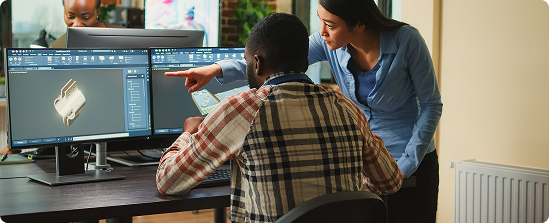
For newer machinists, CNC machine simulation also serves as a powerful learning platform. Operators can visualize toolpaths and machining behaviour in realistic conditions without the fear of damaging expensive equipment.
This helps manufacturers:
-
Accelerate operator training
-
Reduce onboarding time
-
Improve programming confidence
-
Build a more capable workforce
-
Support knowledge transfer between experienced and new machinists
At a time when skilled machinists are increasingly difficult to find, providing teams with tools that improve both safety and learning creates a valuable competitive advantage.
What’s Next for CNC Machine Simulation?
Manufacturers will continue pushing for greater speed, precision, automation and process security, and AI is expected to play a major role in the next evolution of manufacturing technology.
In the latest Vericut release, two new AI-powered tools are designed to enhance the user experience and improve productivity even further:
Vericut Intelligence provides a centralized, easy-to-use knowledge resource for all things about Vericut. Users can communicate naturally with the platform and quickly access product information, guidance, and support resources within seconds.
Vericut Assistant is being enhanced with AI capabilities, enabling users to interact directly with the software in a more intuitive way. This helps users access features faster, streamline workflows, and improve overall efficiency when working with Vericut.
The Bottom Line
CNC machine simulation is about far more than preventing crashes. It transforms manufacturing operations by reducing errors, minimizing wasted time, improving machine utilization, and unlocking new efficiency gains that directly impact profitability.
With advanced verification capabilities, proven real-world customer success stories, and the next generation of AI-driven tools, Vericut continue to help manufacturers stay ahead in an increasingly competitive industry.
By moving test-cuts, optimization and process validation into a digital environment, manufactures are not only protecting their machines, they are future-proofing their entire production process.