
  • You make it, we simulate it.

    Book your free demo today.
    Hero image

    PRODUCTS:

    Robot Simulation
    Software

    Media

    Robot Simulation Software made easy for engineers with Vericut.

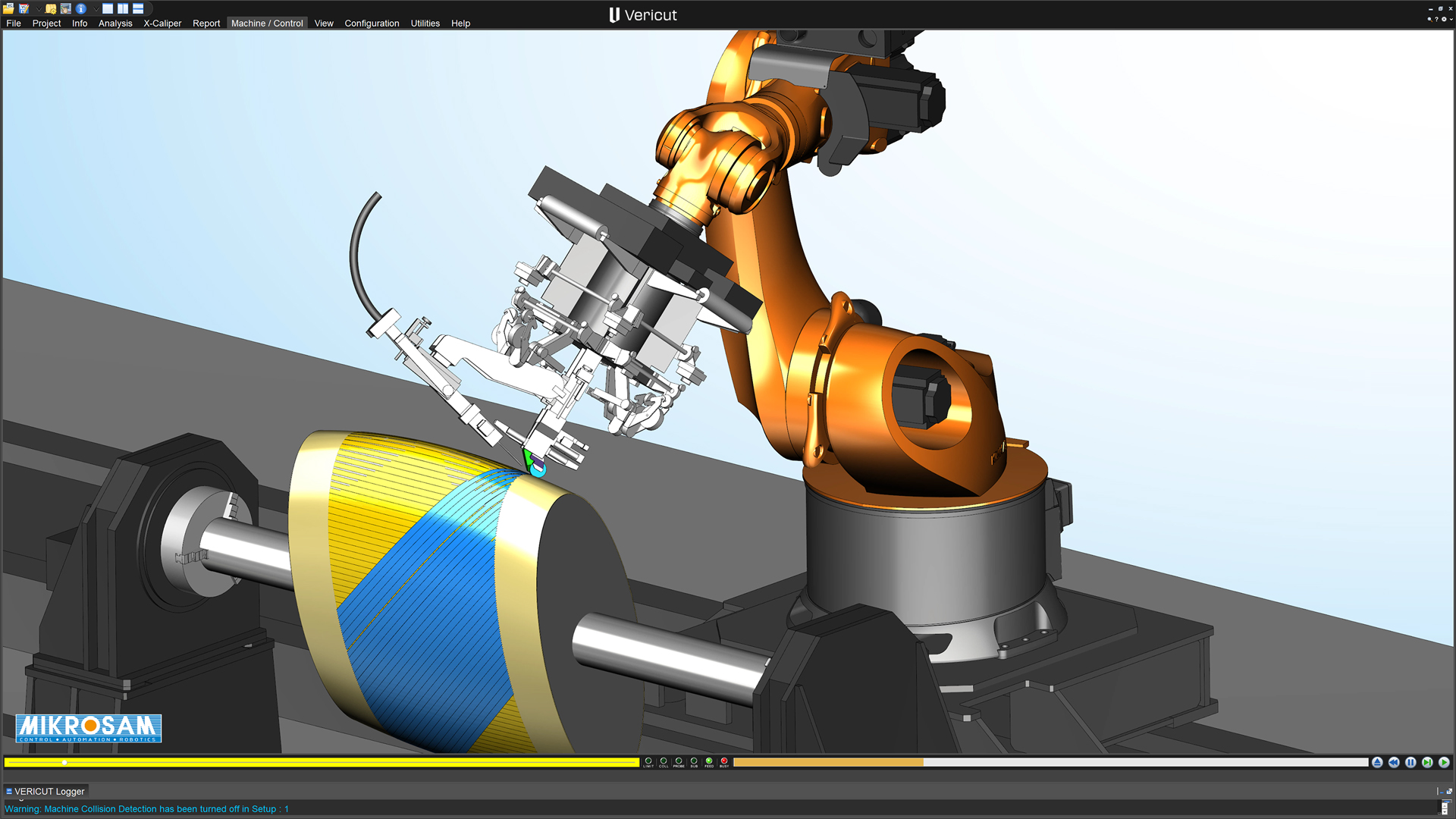
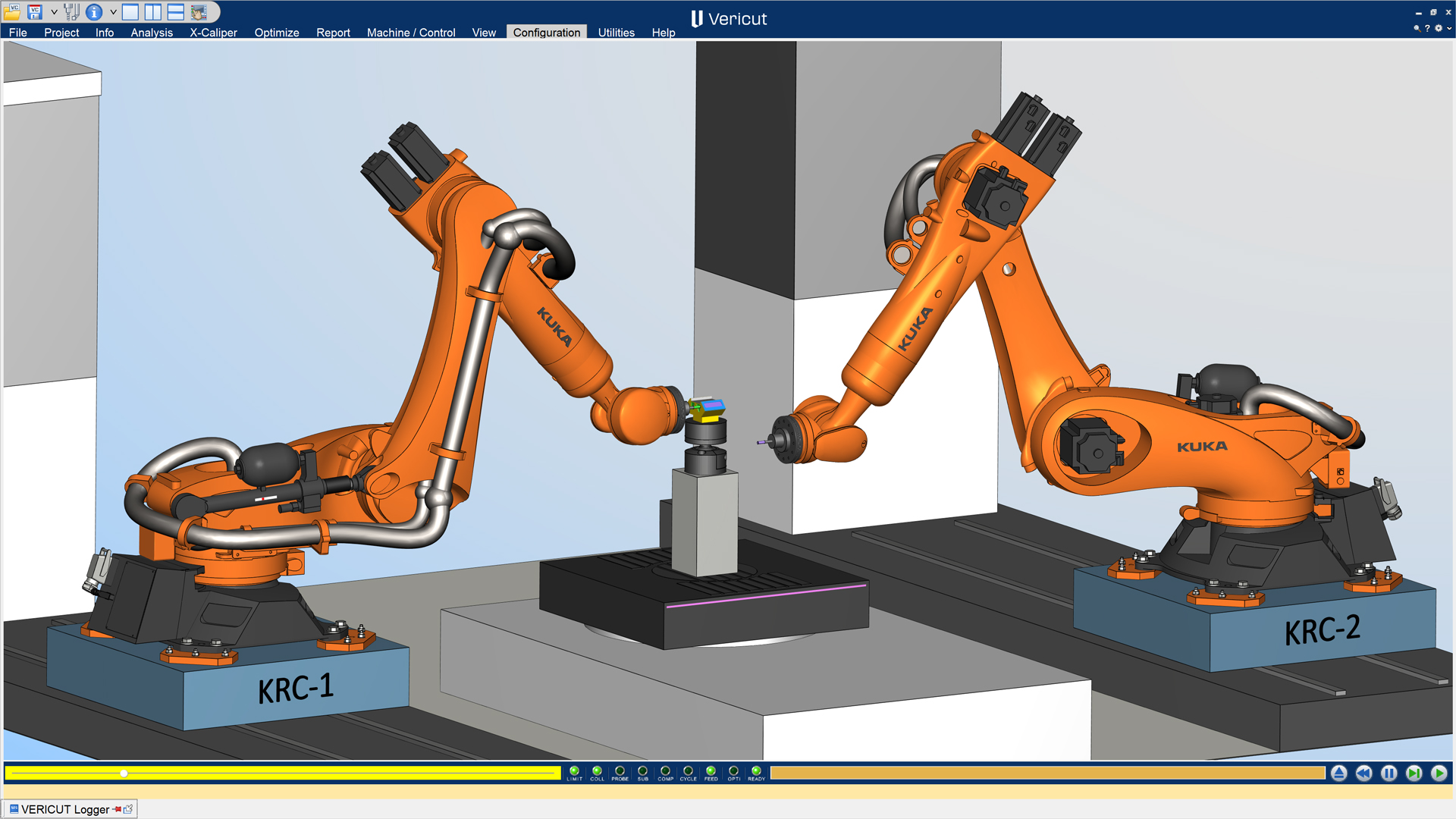
    Vericut’s Robot Simulation software enables engineers to simulate 6-axis articulated robot arms. The software works seamlessly with existing robot systems from leading OEMs, including FANUC, ABB, Kawasaki, KUKA, and more.

    By creating accurate digital twins, Vericut’s Robot Simulation software helps teams to deploy and refine automation systems quicker with fewer errors across various industries. These simulations also offer a safer environment for experimentation and validation, generating valuable insights that closely reflect real-world behaviour.
    Key features and benefits for industrial robots.

    As manufacturing continues to evolve, simulation has become a critical enabler for precision in machine tooling and path planning, while robotics accelerates the adoption of a digital twins across modern production environments, Vericut Robot Simulation plays a vital role by allowing manufacturers to validate, analyze, and refine robotic operations virtually before deployment, ensuring safe, efficient, and predictable automation.  

    3D simulation and digital twins

    Robot Simulation software supports 3D modelling of robotic work cells, including those with external axes such as linear tracks of rotisserie-mounted components.

    Vericut models robots in the same way they are modeled on machine tools, ensuring you have access to their most advanced 3D systems.

    This application can prove out even the most complex sequences and layouts virtually, providing the perfect bridge between theoretical planning and real-world production.

    Optimize robot programming offline

    Production downtime can significantly hurt both productivity and costs. By using simulation, robot programs can be developed and refined without touching the live production line.

    Vericut’s Robot Simulation software offers fast, straightforward motion planning that requires only a few key parameters.

    This allows users to verify movements, troubleshoot issues, and optimize cycle times while keeping production running. This virtual workflow provides a strong competitive edge for high-mix, low-volume operations.

    Analyze results, and improve your performance

    Vericut Robot Simulation software gives engineers a smarter, faster, and more user-friendly way to collect essential production data. It’s an invaluable tool in the toolkit for any manufacturing business looking to improve results and slash errors.

    For example, FANUC robot arms enhance CNC machining through high accuracy, speed, and repeatability supporting reliable machine tending, material handling, and secondary operations. Their robust, IP-rated design delivers consistent performance in harsh machining conditions, while flexible payload and reach options accommodate a wide range of CNC applications. When combined with digital twin and offline simulation technologies, robotic paths and machine interactions can be verified in advance, reducing commissioning time, minimizing risk, and improving productivity and return on investment.

    Eliminate robot collisions for good

    Robot collisions can cause significant damage and expense. Vericut’s Robot Simulation Software removes the possibility of a real-world crash with motion planning and travel limit restrictions. This outcome ensures a smooth, uninterrupted robot operation with no crashes, equipment damage, or safety risks. 

    Watch our Robot Simulation in action.


    frequently asked questions:

    Robot Simulation Softwares FAQs.

    01.
    What CNC machining processes can be automated with robot arms?

    Robot arms can automate machine tending, loading and unloading, part transfer, deburring, polishing, inspection, and palletizing across milling, turning, grinding, and multi-axis CNC machines. 

    02.
    How accurate are robot arms for CNC machine tending?

    Modern industrial robot arms offer high repeatability suitable for CNC machining environments, ensuring consistent part positioning and reliable operation when combined with proper fixturing and calibration. 

    03.
    Can robot arms work reliably in harsh CNC shop-floor environments?

    Yes. Industrial robot arms are designed with sealed joints and IP-rated protection to withstand coolant, chips, oil mist, dust, heat, and vibration commonly found in CNC machining cells. 

    04.
    How does robot simulation benefit CNC machining automation?

    Robot simulation allows manufacturers to validate reach, clearance, cycle time, and collision risks virtually, reducing commissioning time, preventing errors, and improving production efficiency before deployment.

    05.
    What role does a digital twin play in robotic CNC machining?

    A digital twin mirrors the physical CNC machine, robot arm, tooling, and fixtures, enabling accurate verification of robotic paths, machine interactions, and cell layouts for safer and more predictable automation. 

    06.
    Can robot arms be integrated with existing CNC machines?

    Robot arms can be integrated with both new and existing CNC machines using standard industrial interfaces, enabling automation without replacing current equipment. 

    07.
    How does robotic automation impact CNC cycle time and productivity?

    Robotic automation reduces idle time, enables lights-out machining, and ensures consistent operation, leading to improved throughput, higher machine utilization, and better overall equipment effectiveness (OEE). 

    08.
    Is offline programming necessary for robotic CNC machining?

    Offline programming is highly recommended as it allows robotic programs to be developed and tested without interrupting production, reducing downtime and speeding up deployment. 

    09.
    What safety considerations are required for robot arms in CNC cells?

    Safety measures include guarding, interlocks, safety-rated controllers, and validated robotic paths, all of which can be assessed and optimized using robot simulation software. 

    10.
    What is the return on investment for robot arms in CNC machining?

    ROI is achieved through reduced labor dependency, lower scrap rates, faster cycle times, minimized downtime, and more predictable commissioning enabled by simulation and digital twins. 

    Explore more Vericut products.

    Vericut Verification

    Detect errors, eliminate collisions and say goodbye to manual prove-outs once and for all.

    Vericut Force

    Optimize your tool paths and enhance your NC programs for the fastest, most efficient machines, ever.

    AUTO-DIFF™

    Compare CAD design modules to Vericut simulations and detect design differences and weaknesses.

    Multi-Axis

    Verify complex multi-axis machine applications and check for errors at the workpiece and the tool.

    Machine Connectivity & Monitoring

    Create and manage your most accurate digital twins ever by leveraging CNC machine data from your shop floor.

    Brand Icons - light

    Request a demo today.

    See how Vericut Robot Simulation software helps manufacturing businesses like yours improve their processes.