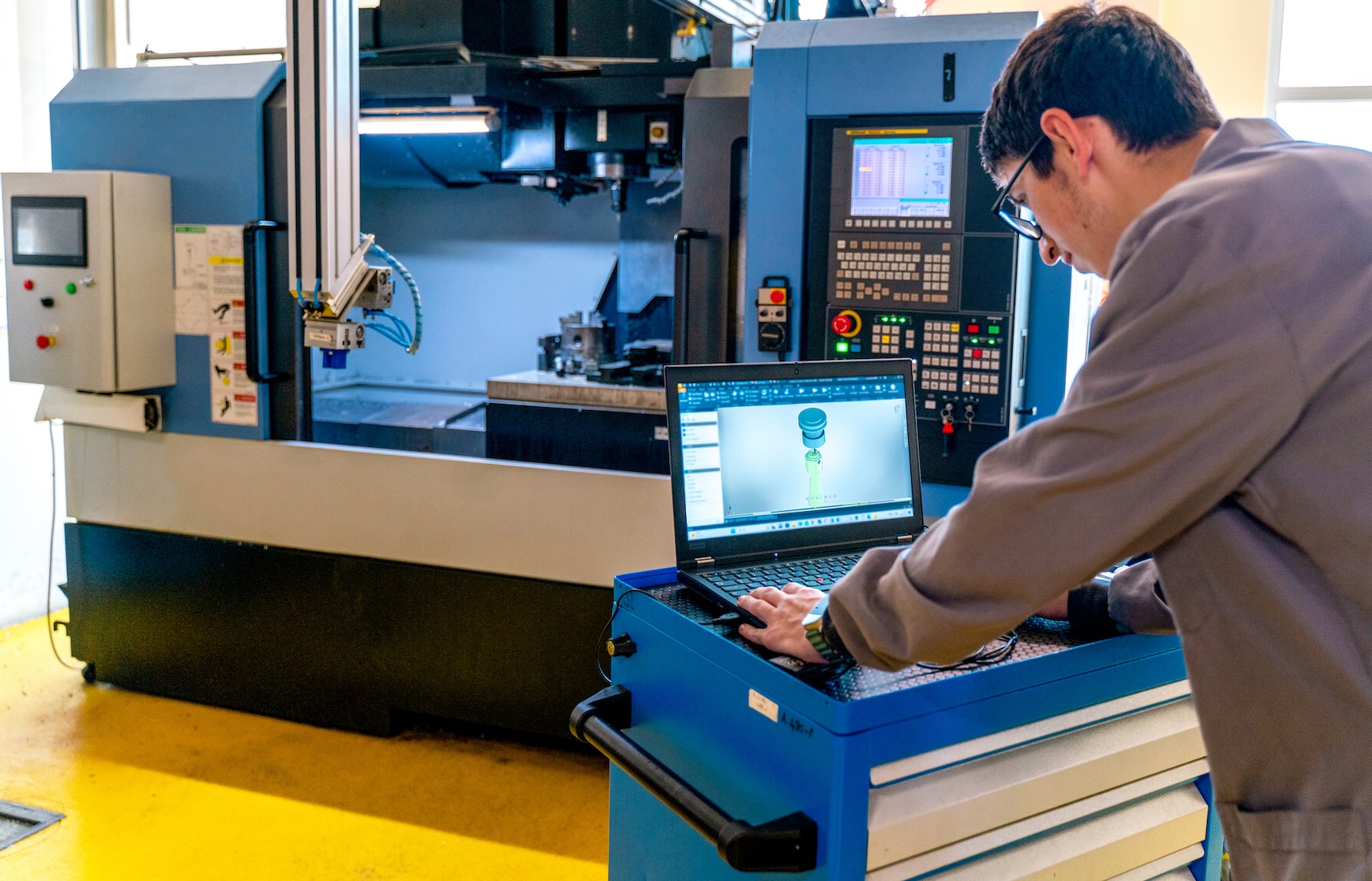
A Universal Holding Fixture, or UHF system, is a flexible fixturing system designed to support a range of part shapes, sizes, contours, geometries and configurations.
Instead of building a dedicated hard fixture for every part, manufacturers can use a configurable fixture with multiple actuators, supports or holding points. These actuators can be positioned to support the workpiece during machining, trimming, routing or drilling.
Universal Holding Fixture systems are especially valuable for large, thin-walled, or low-volume parts, where traditional dedicated fixtures can be expensive to design, build, store, and maintain.
UHF systems are commonly used in aerospace manufacturing, composite machining and large-part production, where flexibility, repeatability, and efficient setup are critical.
.png?width=720&height=759&name=Media%20(49).png)
This can turn UHF programming into a process that takes hours or days, particularly for large aerospace structures, composite parts, or complex machine and fixture combinations.
.png?width=698&height=465&name=Media%20(50).png)
.png?width=720&height=546&name=Media%20(51).png)
In a traditional workflow, programmers often have to work through multiple disconnected steps. If a collision or positioning problem is found, the process loops back into editing, re-posting, and re-simulating.
With Icam UHF programming software, post-processing and simulation work together. The software helps automate actuator positioning, simulate the machine and fixture environment, and generate NC code that reflects both the CNC machine, and the UHF system.
Collision avoidance is one of the most important requirements in UHF programming.
During machining, a cutting tool may approach fixture supports, actuators, vacuum elements, or other holding components. If the fixture position is not correctly programmed, the result may be tool damage, fixture damage, part scrap, machine downtime or a failed prove-out.
Icam UHF programming software helps reduce this risk by simulating the combined machine and fixture environment before the program reaches the shop floor. This allows programmers to identify actuator interference, tool-to-fixture collisions and other possible issues early in the programming workflow.
.png?width=698&height=465&name=Media%20(52).png)
.png?width=698&height=465&name=Media%20(53).png)
Icam UHF programming technology integrates machine simulation into post-processing. This is important because UHF programming is not only about where the fixture actuators should be placed. It is about how the complete system behaves during machining.
Machine simulation can help validate:
|
|
By using simulation earlier in the workflow, programmers can reduce the need for repeated trial-and-error cycles and create safer, more reliable CNC programs.
.svg)
Talk to Vericut about your Universal Holding Fixture system, CNC machine, CAM software, and production requirements.
Our team can help you understand how Icam UHF programming technology can reduce manual programming effort, automate actuator positioning, support collision avoidance, and generate machine-ready NC code.
.png?width=720&height=546&name=Media%20(54).png)

See how Vericut CNC simulation software can help your business forgo its CNC machining frustrations.
Address:
Vericut USA
CGTech Corporate Headquarters
9000 Research Drive
Irvine, California
92618-4214
Phone:
(949) 753-1050