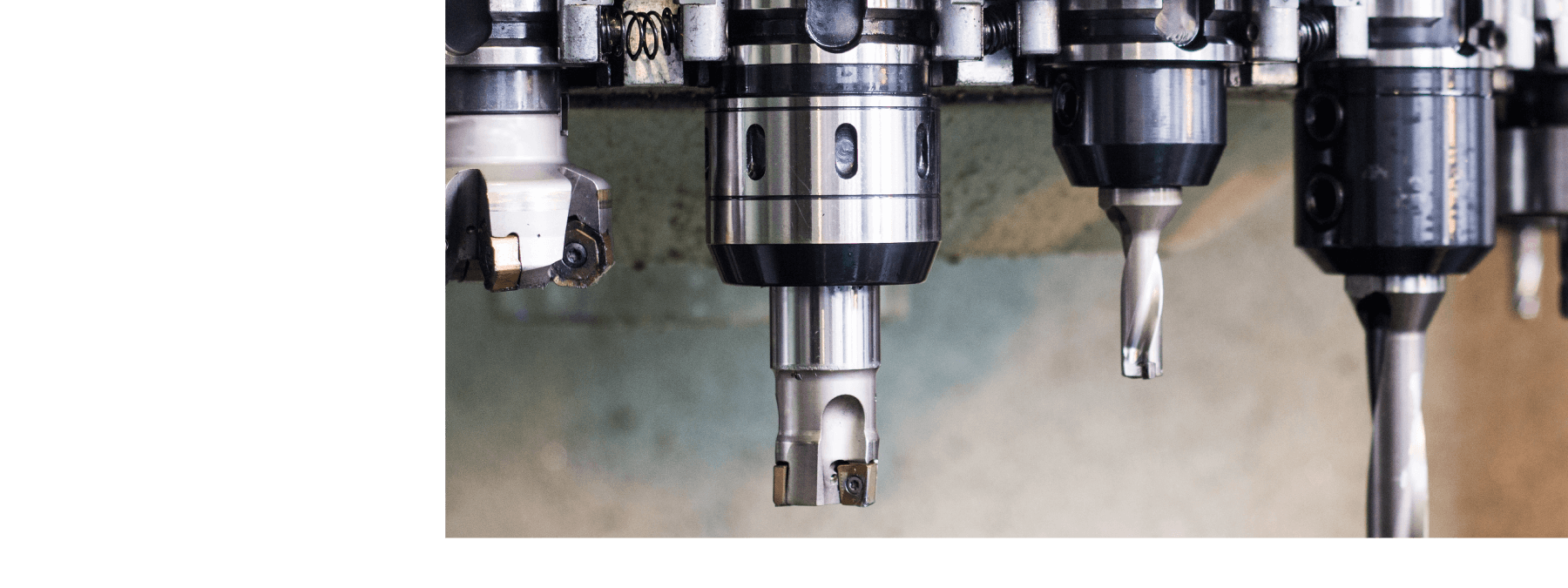
Create your most powerful NC programs yet. Vericut interfaces make connecting directly with your existing CAD/CAM software easy—from Mastercam, Siemens NX, and CATIA V5 to GibbsCAM, PowerMill, and more.
Vericut effortlessly integrates with the globe’s leading CAD-CAM programs.





Our Quick Start training sessions are designed to teach the fundamentals of running a Vericut simulation by utilizing one of several available Vericut CAM Interfaces. Each set of training files includes videos, documentation, sample files, and exercises for the user to follow along.
Tool management interfaces extract tool lists from your tool manager system and create Vericut tool assemblies via a live connection to your tool manager.







.png?width=698&height=465&name=Media%20(9).png)
.svg)
Work directly with your existing CAM system without starting over.
.svg)
Cut out repetitive steps by importing data straight into Vericut.
.svg)
Keep toolpath strategies, tolerances, and setups consistent for trustworthy performance.
.svg)
Quickly transfer CAD models, post-processed NC code, and full machine setups — all preserved for accurate simulation.
.svg)
Interfaces are continuously updated to stay compatible with the latest CAM software versions.
We know that every CAM system has its quirks. That’s why Vericut interfaces are intuitively tailored to make the handoff from programming to simulation as smooth as possible.
Here’s how Vericut works with some of the most widely used CAD-CAM platforms.
Direct connection between NX and Vericut, with no need for complicated workarounds.
Transfer toolpaths, from simple drilling cycles to complex 5-axis operations, straight into Vericut.
Maintain your NX tool libraries and machine setups so simulations reflect your programming environment.

Dedicated Vericut plug-in makes it easy to send projects from Mastercam.
Supports multi-axis strategies and high-speed machining paths.
Keeps tool definitions, fixtures, and part models consistent between Mastercam and Vericut.

The GibbsCAM interface delivers a seamless connection, transferring toolpaths and model data with total precision.
Streamlines verification by allowing toolpath and NC code validation directly within Vericut.
Optimal for aerospace, automotive, and precision applications that depend on GibbsCAM for advanced multi-axis machining.
.png?width=180&height=84&name=Partner%20Logo%20(1).png)
The CATIA V5 interface connects directly to Vericut, ensuring CATIA models are carried across with full fidelity.
Ideal for aerospace and automotive users who rely on CATIA for complex assemblies and high-value parts.
Enables the validation of toolpaths and NC code without recreating models or setups.
.png?width=180&height=84&name=Partner%20Logo%20(2).png)
Quickly export toolpaths from PowerMill and run them inside Vericut.
Supports adaptive roughing, high-speed machining, and advanced strategies used in PowerMill.
Helps bridge the gap for smaller shops or teams who need enterprise-level simulation power alongside PowerMills’s flexibility.
.png?width=180&height=84&name=Partner%20Logo%20(3).png)
Full support for toolpaths generated in hyperMILL and SolidCAM.
Maintains precision machining strategies and toolpath tolerances.
Confirms that even the most complex geometries are safe to cut before they reach the machine.
.png?width=180&height=84&name=Partner%20Logo%20(4).png)
Seamless Integration:
The Siemens RMVM ↔ Vericut interface delivers the best of both worlds, helping you save time, reduce risk, and maximize efficiency.
.png?width=180&height=84&name=Image%20Card%20(1).png)

See how Vericut CNC simulation software can help your business forgo its CNC machining frustrations.
Address:
Vericut USA
CGTech Corporate Headquarters
9000 Research Drive
Irvine, California
92618-4214
Phone:
(949) 753-1050


 Deutsch – Deutschland
 English - United Kingdom
 English - India
 English - Singapore
 Español
 Français - France
 Italiano - Italia
 日本語 - 日本
 한국어 - 대한민국
 Português - Brasil
 Svenska – Sverige
 简体中文
简体中文












.svg)