
 English - United Kingdom
 English - Singapore
 한국어 - 대한민국

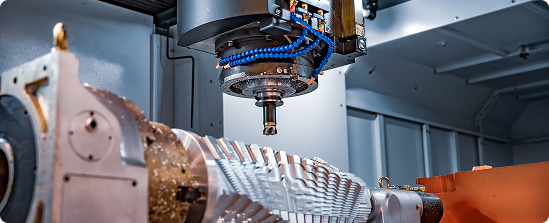
CNC programming is at the heart of modern manufacturing. From aerospace turbines to automotive engine blocks, CNC machine programs transform digital designs into precisely machined parts. But without the right processes in place, programming can become a source of delays, errors, and cost overruns.
In this guide, we’ll explain CNC programming, why it matters, the different approaches available, and how simulation software can dramatically improve confidence in your programs.
What exactly is CNC programming?
CNC programming refers to the process of creating instructions that direct machine tools on how to cut, drill, or mill a part. These instructions, often written as machine G-code, define tool movements, feed rates, and spindle speeds, ensuring that every operation follows exact specifications.
In practice, CNC programming bridges the gap between CAD designs and the shop floor.
Whether it’s in aerospace, automotive, energy, or consumer goods, the role of CNC programming is the same: to ensure accuracy, repeatability, traceability, and efficiency across the entire production process.
And Vericut captures more programming errors than any other CNC software on the market.
What is G-code?
In short, G-code is the standard language of CNC machines.
It tells the machine how to move, what path to follow, and at what speed. While CAM software generates G-code automatically, understanding its role is vital for reviewing, adjusting, and troubleshooting programs.
For manufacturers, knowing that the actual post-processed G-code has been verified before it reaches the machine is essential. That’s why G-code level simulation provides the highest level of confidence.
Are you serious about precision, efficiency, and protecting your machines? Then our reveal-all G-code guide is an essential read for you.
Why is CNC programming important?
CNC programming is not simply about running a machine — it’s about helping manufacturers run their machining suite correctly, consistently, and safely.
Precision and repeatability.
Parts can be manufactured to exact tolerances, cycle after cycle.
Error and risk reduction.
By removing guesswork and manual intervention, programming minimizes human error.
Cost effectiveness.
Fewer mistakes and reduced scrap lead to significant savings.
Shop floor scalability.
Once validated, a program can be confidently deployed across multiple machines or production runs.
Data collection and insights.
Programming information is captured and stored to support future projects.
For Vericut customers, the value of our CNC programming capabilities goes beyond “just programming”. The programs can test, verify, and optimize toolpaths and unique machine behaviors before cutting metal - saving both time and materials.
.jpg?width=640&height=260&name=Media%20(1).jpg)
What are the different types of CNC programming?
Manual CNC programming.
This is the traditional programming method, which involves writing G-code line by line. While it offers complete control, it’s time-consuming and prone to error, making it impractical for complex or high-volume jobs.
CAM CNC programming.
Most manufacturers now rely on Computer-Aided Manufacturing (CAM) software, which converts CAD models into machine-ready toolpaths. CAM software automates much of the process, improving efficiency, and lowering the barrier to entry for less experienced programmers.
Hybrid CAM/manual CNC programming.
A mix of the two types above. It has some human inventions to overcome the specific programming challenge the programmer might be facing. The trouble is that now the program is no longer solely produced by the CAM, so it cannot be exactly verified.
Other programming methods.
-
Conversational programming: simplified interfaces for creating programs directly at the machine.
-
Adaptive programming: toolpaths that adjust to real machining conditions.
Choosing the right method.
The best approach depends on part complexity, production volume, and available expertise.
For high-precision, multi-axis, or multi-process parts, CAM CNC programming combined with a powerful verification and simulation software like Vericut provides the most robust and reliable workflow.
What are the benefits of using CNC programming software?
While choosing between manual, CAM, or other methods depends on your production needs, one common factor remains: the right software makes every approach more effective.
From automating routine tasks to optimizing complex toolpaths, CNC programming software transforms programming from a manual chore into a driver of efficiency and accuracy.
Automation and precision.
Reduces manual coding while improving accuracy.
Increased efficiency.
Accelerates the design-to-production cycle.
Heightened flexibility.
Makes it easy to adapt to customer changes or design updates without disrupting the whole process.
Parts consistency.
Ensures every part meets specification, essential for industries with strict compliance standards, or working in hybrid CNC/manual programming environments.
Reduced human error.
Automated toolpath generation and verification lowers the risk of costly mistakes.
Advanced capabilities.
Unlocks complex machining operations, such as multi-axis milling, Swiss-style machining, hybrid systems, and 3D metal toolpaths.
How does CNC simulation improve CNC programming?
CNC Programming and G-code provide the machining foundation, but don’t guarantee success on the shop floor.
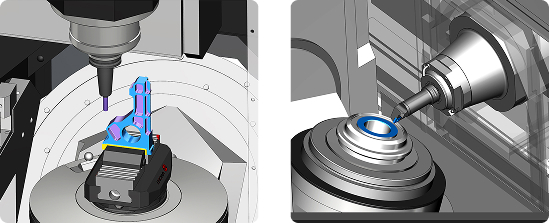
Even the most carefully written program can produce unexpected results once it’s running on a real machine. This is where CNC simulation software becomes essential—it turns programming theory into reliable, real-world performance.
Visualize real machining in a virtual environment.
Unlocks complex machining operations, such as multi-axis milling, Swiss-style machining, Spot issues before they reach the shop floor, ensure you made the part you intended, and capture analytics and data to improve future performance.
Validate and compare designs.
Ensure consistency and confidence between CAD design files, and simulated components.
Verify toolpaths.
Eliminate collisions, over-travel, and inefficient moves.
Detect errors early.
Catch mistakes that would otherwise waste time, material, and tooling.
Optimize processes.
Adjust feeds, speeds, and strategies to achieve maximum performance, ensuring your part is correctly programmed for its material, geometry, and cutting conditions.
Integrate seamlessly with CAM.
Verify toolpaths from leading CAM systems in a single workflow.
By simulating the exact program that will run on the machine, Vericut gives manufacturers confidence that their CNC programs will deliver the expected result, without the risk.
-1.jpg?width=638&height=259&name=Media%20(9)-1.jpg)
Closing thoughts.
CNC programming is the backbone of modern manufacturing, enabling companies to produce parts with speed, precision, and repeatability. But programming alone isn’t enough.
Without verification, even the most carefully created toolpath can lead to costly mistakes, wasted material, or downtime.
By combining CAM, G-code, and simulation, manufacturers can transform CNC programming into a genuine competitive advantage. Simulation software doesn’t just prevent errors — it provides confidence. It allows you to experiment with new designs, optimize existing processes, and push your machines to achieve their full capabilities, all in a safe virtual environment.
This is where Vericut truly comes into its own. By simulating the actual G-code on a digital twin of your machine, Vericut ensures that every program you release is safe, accurate, efficient, and production-ready.