

 日本語 - 日本

By Frankie Cates, Director of AI and Cloud Architecture at Vericut.
We all know that Artificial Intelligence (AI) is transforming industries at an incredible pace.
What will AI actually look like inside a CNC machining environment where G-code, machine kinematics, tooling, and material properties and cutting behavior must all be accounted for?
How does it affect programming, verification, and optimization? This article looks to answer these questions.
The introduction of computer numerical control (CNC) machines was revolutionary. Now, the
integration of AI in CNC machining promises another leap forward. But unlike other commercial industries, where AI can be quickly integrated and commoditized, CNC machining depends on trusted G-code and optimization to meet the increasing demands of a highly competitive industry.
What matters to CNC programmers, manufacturing engineers, and shop managers is not if AI will change programming and verification workflows, but how. A wrong answer from AI isn’t just inconvenient; it can break a tool, scrap a part, or worse, damage a machine.
That’s why AI in CNC machining has to be more than just “productive.” It must operate within an accurate digital twin that reflects verified G-code, machine kinematics, tooling data, and material response under machining conditions.
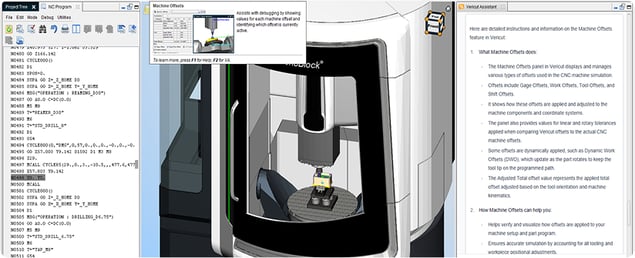
Vericut’s simulation environment is that accurate digital twin. Vericut’s new AI features are built directly on this foundation, providing a practical, grounded application of AI within proven CNC verification workflows.
Vericut introduces Vericut Intelligence (VI) and Vericut Assistant (VA)
The latest release of Vericut introduces Vericut Intelligence (VI) and Vericut Assistant (VA),
offering one of the clearest examples of practical AI applied directly to CNC verification,
simulation, and optimization today. VI and VA show how AI can be embedded directly into
machining and programming workflows, reducing errors, accelerating training, and making
complex machining more accessible.
Vericut Intelligence (VI): The Knowledge Layer
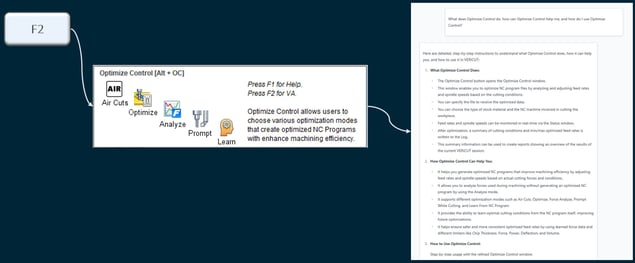
Vericut Intelligence (VI) acts as a knowledge layer for the entire Vericut software suite, including Verification, AUTO-DIFF, Force Optimization, Multi-Axis, and Vericut’s many other powerful features. By centralizing product knowledge, VI shortens the learning curve and helps both novice and advanced users make the most of Vericut’s capabilities.
Instead of consulting manuals or searching forums, users can ask VI questions quickly and
directly:
• “What is X-Caliper?”
• “How does Force Optimization improve cycle time?”
Vericut Assistant (VA): From Guidance to Action
Where VI explains, Vericut Assistant (VA) guides and does. Today, VA can answer “how-to”
questions with step-by-step guidance. Tomorrow, it will go further, executing tasks directly in
the software.
For example, instead of manually configuring a cutting tool in the tool library, you could say,
“Add a tool: 12 mm carbide end mill, four flutes, 60 mm overall length,” and VA will populate
the correct CNC tool definition.
This progression is significant. It turns VA into an AI CNC verification and optimization assistant, streamlining workflows and reducing context switching. The result is fewer errors, faster programming, and more efficient use of advanced features. From accelerating onboarding to reducing errors and unlocking advanced capabilities, AI tools like Vericut Intelligence (VI) and Vericut Assistant (VA) are already demonstrating how AI in CNC machining can deliver measurable results.
Across manufacturing, including CNC-driven industries, AI is already being applied in diverse and tangible ways beyond the programming process alone.
For example, automotive manufacturers use AI-driven vision systems to perform inspection of
body panels and components, detecting surface defects far faster and more consistently,
helping make quality assurance even more efficient.
In aerospace, AI is employed in analyzing vibration, spindle load, temperature, and data from
CNC machines to anticipate failures before they occur, reducing downtime and improving ROI.
In CAM programming, AI can make suggestions for tooling and machining strategy based on
past toolpaths and similar part programs.
These AI use cases in manufacturing highlight how intelligent systems can reduce costs, improve quality, and increase throughput, setting the stage for solutions like Vericut’s AI to thrive within manufacturing.
What does the bigger picture look like for AI in CNC machining and manufacturing?
The integration of AI in CNC machining is reshaping not only how CNC shops scale expertise and ensure repeatability, but also how parts are programmed, verified, and machined.
Vericut already eliminates prove-outs and helps prevent machine tool crashes, scrapped parts, damaged tooling, and other costly issues. By placing AI in this established context of CNC verification, these capabilities can be further augmented and enhanced, taking CNC
programming and machining workflows to the next level of intelligent production.
What are some concerns about AI’s role in the manufacturing industry?
While the potential of AI in manufacturing is vast, it also raises important requirements.
Manufacturers operate in environments where mistakes can be costly and intellectual property needs to remain confidential.
Manufacturers are rightly cautious about the role of data privacy, especially as AI technologies become increasingly integrated into shop floors. Vericut Intelligence (VI) and Vericut Assistant (VA) address this head-on: customer data is not used to train the AI. Nor will it be in the future.
Vericut’s AI operates directly from CNC machining knowledge, not from your data. That makes Vericut’s AI a trusted resource in industries like aerospace and automotive, where security and confidentiality are paramount. The introduction of Vericut Intelligence and Vericut Assistant marks the beginning of a long-term strategy to integrate AI into Vericut’s products, with the ultimate goal of maximizing productivity while ensuring privacy.
The future of AI. Will AI replace CNC programmers and machinists?
AI-driven methods are beginning to reshape CAM programming by interpreting complex
geometries, automating toolpath strategies, and enabling adaptive machining workflows that
can reduce setup time.
However, once those toolpaths become executable G-code, machine kinematics, control
definitions, tooling libraries, material and cutting characteristics, and machine parameters all
influence whether a program will run correctly. AI-driven assistants like Vericut Assistant (VA)
leverage all of this information, making independent verification even more critical in the
evolving world of complex machining.
AI will not replace CNC programmers and machinists. In fact, it makes their skills even more
valuable. AI doesn’t replace the knowledge that experienced programmers and machinists bring to the shop floor. For example, AI can suggest feeds, speeds, and cutting strategies, but only a skilled CNC programmer understands the nuances of a specific machine and must start from a known working configuration before AI can be leveraged.
The future of AI in CNC machining and manufacturing is not about replacing human expertise.
It’s about embedding intelligence where it adds the most value: G-code verification, simulation,
and optimization. Manufacturers who adopt these tools can unlock advanced machining
strategies while maintaining the trust and reliability that CNC production demands.
About the Author
Frankie Cates is the Director of AI and Cloud Architecture at Vericut, where he plays a critical
role in advancing the company’s mission to deliver trusted, intelligent CNC verification and
optimization solutions. With over two decades at Vericut, Frankie has been instrumental in
shaping the architecture behind many of the company’s most impactful innovations, including
the development of Vericut’s cloud licensing platform, now relied upon by thousands of users
worldwide. He also developed Vericut’s cloud-based notification system, enabling real-time
alerts when simulations are completed and when errors or warnings are detected. As the
architect behind Vericut Intelligence (VI) and Vericut Assistant (VA), Frankie continues to lead
the integration of AI and cloud technologies that enhance productivity, improve reliability, and
take CNC programming and machining workflows to the next level.
-1.jpg)
.jpg)