• You make it, we simulate it.

    Book your free demo today.
    Hero image

    free guide:

    Unlock automotive smart manufacturing

    Brand Icons - light (1)

    Discover how leading automotive manufacturers are using CNC simulation to cut costs, boost productivity, and remain competitive in a rapidly changing market.

    This free guide explains how virtual CNC software enables safe, efficient, and agile machining—before a single chip is cut.
    Inside, you’ll gain expert insight into overcoming supply chain disruption, lowering energy consumption, and training teams more effectively. Whether your goal is to optimise cycle times or strengthen sustainability initiatives, this guide offers a practical roadmap for modernising machining operations.


    Download the guide to unlock smart manufacturing for the automotive industry

    7 min read time

    Automotive Smart Manufacturing

    In the fast-moving world of automotive manufacturing, innovation is non-negotiable. Against this backdrop, virtual Computer Numerical Control (CNC) software has emerged as a transformative technology, reshaping traditional production processes. This white paper examines the impact of virtual CNC software on automotive manufacturing, highlighting its role in improving efficiency, precision, and operational agility.

    Virtual CNC software allows automotive manufacturers to simulate and optimise machining processes before physical production begins. By digitally modelling components and machining operations, errors are reduced, lead times shortened, and resource usage optimised—driving greater productivity and cost efficiency. This approach also supports innovation in product design and customisation, enabling rapid prototyping and iterative development.

    In addition, realistic machining simulations provide operators and engineers with the opportunity to build skills in a safe, controlled environment, without relying on costly physical prototypes or machine time.

    As the automotive industry continues to evolve, the adoption of virtual CNC software has become a strategic necessity. By embracing this technology, manufacturers can unlock new opportunities for growth, efficiency, and innovation.

    Vericut’s commitment

    The automotive industry has undergone significant change, and those that have endured have done so through preparedness and adaptability. More recently, the transition towards electric vehicles—and the future of increasingly autonomous vehicles—has introduced new and complex challenges.

    Alongside other priorities, energy-efficient manufacturing—reducing energy consumption while improving sustainability—has become a key focus for manufacturers. To meet these challenges, automotive businesses must rapidly and strategically reallocate budgets. Research and development efforts increasingly need to focus on software and manufacturing feasibility. The right software must enhance product performance while keeping costs under control.

    The emphasis must be placed on processes rather than individual machines, systems, or functions. Even during economic downturns, swift and decisive investment in next-generation technologies that enable better workflows cannot be overlooked.

    Smart alternatives in automotive manufacturing are fundamentally driven by rigorous digitisation. It is no coincidence that NC simulation is regarded as a lighthouse project and early mover among digital transformation initiatives, acting as the interface between CAM programming, work preparation, and the shopfloor.

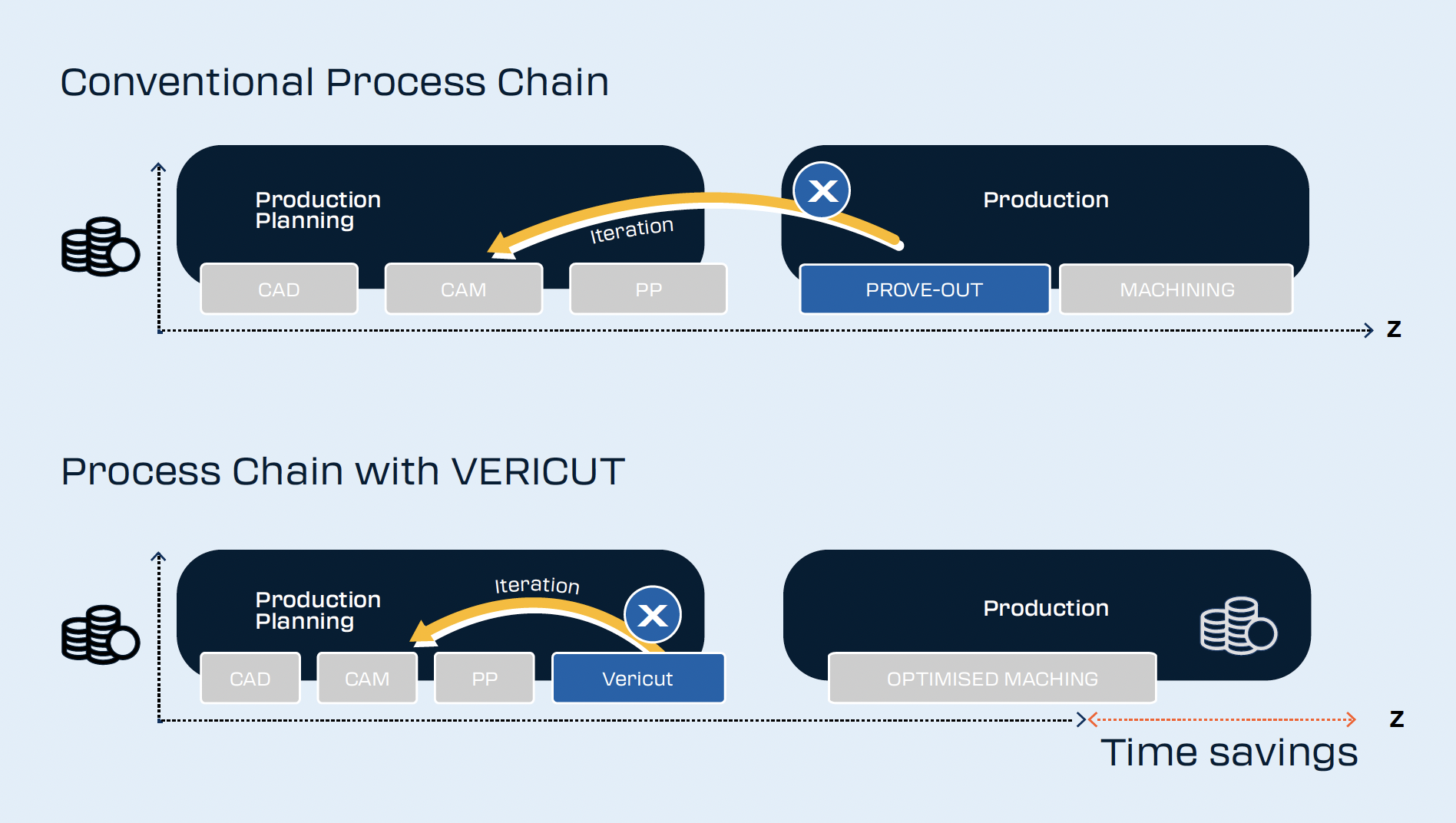
    Manufacturing simulation of NC data—the actual machine code—addresses the most critical areas in metal-cutting production: safe prove-outs for complex clamping scenarios, scrap-free manufacturing, collision-free machining, increased tool life, faster NC programs, reduced machining times, and improved part quality.

     

    Frame 48095835


    Be prepared

    Frequently asked questions - resilience & NC simulation

    01.
    What are the most common challenges faced by CNC manufacturers in the automotive sector?

    To remain resilient and prepared, automotive manufacturers must be responsive and adaptable, which requires clear visibility of potential issues, disruptions, and risks. Producing high-quality machined automotive parts in the shortest possible time and at the lowest achievable cost remains the industry’s greatest challenge. 

    02.
    What measures can CNC manufacturers take to reduce the impact of material shortages on automotive production?

    No organisation can accurately predict the future in full. Environmental and economic conditions are complex, as are internal manufacturing systems. To mitigate the effects of supply shortages, manufacturers should work with reliable suppliers and, where possible, establish alternative production strategies—such as using different CNC machines or switching from castings or forgings to plate stock. Software plays a critical role in tracking, planning, and optimisation.

    03.
    How do supply chain disruptions affect CNC manufacturers supplying the automotive sector?

    Supply chain disruptions can have severe consequences, directly impacting part costs and production schedules. When required materials are delayed or unavailable, manufacturers may be forced to source alternatives at short notice, increasing procurement and delivery costs. In some cases, machining strategies must be reworked entirely to accommodate available materials rather than original plans.

    04.
    What are the major challenges in maintaining precision and quality in automotive CNC machining?

    One of the most significant challenges is achieving consistent part accuracy. It is rarely practical to inspect every component, so quality checks are typically carried out on sample parts within a batch.

    If defective parts are later identified, the consequences can be serious—disrupting assembly lines, damaging supplier reputations, or even resulting in cancelled contracts.

    Another key challenge is surface quality, particularly for tooling such as body panel moulds and dies. These components require significant machining time, which must be carefully accounted for during production planning.

    05.
    How do technological advancements affect CNC manufacturing in the automotive sector?

    Reducing costs while improving operational efficiency is essential for automotive manufacturers to remain competitive. Manufacturing technology supports resource planning, monitors shopfloor throughput, and increases automation.

    Advanced manufacturing software can optimise NC programming strategies, as well as feeds and speeds at the tool level, enabling levels of machining performance and part quality that were previously unattainable.

    21 Challenges

    Automotive industry: 
Machining at the limit

    <p>The automotive industry places extremely high demands on machining operations.</p> <p>The pursuit of high quality and high production volumes remains critical, while cycle time—measured in seconds and pennies—continues to drive cost pressure. The shift towards hybrid vehicles is accelerating, with plug-in hybrids gaining popularity. The future lies in battery-electric and fuel-cell electric vehicles, collectively known as NEVs (New Electric Vehicles).</p> <p>These industry changes require entirely new components, including electric motor housings, new gearbox designs, specialised covers, and a wide range of E-mobility-related accessories. As a result, manufacturers face increasing demand for retooling, new tooling, and revised manufacturing processes.</p> <p>These pressures create a series of challenges spanning CNC programming, planning, and production. Below is a summary of the key issues.</p>

    01.

    Requirements for product quality 

    Safety-critical components economic consideration. 

    02.

    Machining of new materials 

    Demand for safe, reliable, and high-quality processes. 

    03.

    Demands for higher process quality 

    Scrap and collisions versus high raw material and energy prices; delivery timelines; small profit margins. 

    04.

    Timely integration of new manufacturing processes

    Integration of state-of-the-art technology during operation. 

    05.

    Investing in technology with future perspective

    Prompt return on investment even with small quantities; sustainability in financial & operational strategies.

    06.

    Personnel continuity and securing corporate know-how

    Increased fluctuation, higher illness rates, lower motivation due to performance pressure and changing generations on the shop floor.


    07.

    Developing holistic process view 

    Based on the digital twin of machine, workpiece and machining process, the potential offered by the visualisation of future processes is to be developed. 

    08.

    Reducing material costs

    Proactive reduction of later operating costs.

    09.

    Maintaining complete production documentation 

    Traceability of the product lifecycle for maintenance, material recycling

    10.

    Business management manufacturing

    Margin pressures especially when mitigating supply chain disruptions and shortages alongside fluctuations in demand.


    11.

    Unconditional delivery reliability 

    Timely delivery of safetycritical products.

    12.

    Digitalisation with future perspective

    Prerequisites for industry 4.0 with artificial intelligence, machine learning, augmented reality, predictive maintenance etc. 

    13.

    Reduce replacement of spindles 

    High spare parts costs, expensive downtime, loss of earnings, loss of reputation. 

    14.

    Process transparency

    Production and plant management need consistent data as a basis for planning. 


    15.

    Shortening machine downtimes

    Necessity to reduce production latency times. 

    16.

    Achieving zero waste and reducing scrap parts 

    High raw material costs, short tool life, managing chip thickness, loss of earnings, loss of reputation. 

    17.

    Minimising schedule interruption

    More problematic with longer cycle run times. 


    18.

    No broken tools & holders 

    High cost of spare parts, expensive downtime, loss of earnings, loss of reputation.

    19.

    Maintaining sufficient machine capacity

    Have room for agility during order peaks without buying additional machines. 


    20.

    Reducing repair & replacement of fixtures 

    Required for lower expenses (time, personnel, spare parts etc.) 


    21.

    Maintain high-quality, timely processing

    Reduce orders lost due to quality issues or slow time-to-market.


    5 Grand challenges in the automotive industry

    1. Supply Chain Disruptions: 

    Disruptions caused by geopolitical events, natural disasters, or market volatility can result in shortages and price fluctuations. Anticipating these risks is essential to maintaining stable and resilient operations.

    Tip: In addition to traditional supply chain strategies, manufacturers must achieve new levels of internal efficiency. Planning production correctly from the outset and using digital solutions that combine quality assurance with autonomous production control improves overall resource efficiency. 


    2. Technological Advancement

    Rapid developments in electric vehicles and autonomous systems require manufacturing processes that are flexible and adaptable. This demands continued investment in new technologies and production initiatives.

    Tip: New vehicle technologies require new components, tooling, and manufacturing processes. High-volume production remains essential, and errors can be extremely costly. Consider the entire production environment—from machines and automation to floor space, materials, and capital investment—alongside accurate process planning data such as operations, tooling, cycle times, and production targets. 

    3. Sustainability & Environmental Regulations:

    Sustainability is both a regulatory requirement and a societal expectation. When implemented correctly, sustainable manufacturing practices reduce environmental impact while maintaining efficiency and compliance.

    Tip: Reducing CO₂ emissions depends on efficient use of materials and energy. Digitising manufacturing processes reduces waste, energy usage, and time lost to manual prove-outs. Virtual testing eliminates the need for physical trial runs, preventing scrap and avoiding machine damage.

    Optimised NC code can reduce cycle times by 10–40%, depending on part complexity and materials, delivering significant savings in energy and operational costs.

    4. Quality control & Product Safety:

    Maintaining quality and safety standards is critical in automotive manufacturing. Early detection of defects through robust quality control processes is essential for meeting schedules, controlling costs, and ensuring customer satisfaction.

    Tip: Every stage—engineering, design, CAM programming, and machining—should be verified and optimised. Simulation and verification ensure error-free programs, while optimisation ensures processes operate as efficiently as possible.

    5. Workforce Skills & Training:

    Ongoing workforce development improves productivity, quality, and consistency while reducing waste and rework. As manufacturing technologies evolve, skills must evolve with them.

    Tip: Skilled machinists are increasingly difficult to recruit. With many experienced professionals nearing retirement and a shortage of new talent, manufacturers must work smarter. Software provides valuable insights that streamline workflows and reduce reliance on scarce skills.

    CNC simulation verifies parts, simulates machining, and optimises NC code before production begins—making unattended and lights-out machining a realistic option.


    3 Facts about NC simulation

    1. Procedures in Profile

    Wherever milling, drilling, or turning is driven by NC programs, simulation tools verify and optimise the post-processed NC code. This is a proven best practice for manufacturing optimisation.

    Special benefits for automotive:

    Independence from CAM systems and machines supports connectivity across diverse manufacturing environments.

    2. Present & Future

    Simulation enables manufacturers to plan future processes with confidence by identifying errors before physical machining begins.

    Special benefits for automotive:

    Shorter cycle times, safe prove-outs, longer tool life, reduced breakage, and collision-free machining deliver tangible returns.

    3. Resource Management

    NC simulation improves production planning accuracy by precisely determining machining times. This enables parallel workflows, improved machine utilisation, and reduced rework.

    Special benefits for automotive:

    In an environment of skilled labour shortages and rising demands, effective resource management is essential to maintaining competitiveness.

    f04f833b64fd60d87d188b70eb71fb652c16874c

    Capital expenditures & Depreciation NC simulation

    The industry faces intense pressure to innovate, requiring careful financial and operational balance. New technologies, materials, and processes present significant challenges—particularly for mid-sized suppliers.

    While innovation budgets are often heavily scrutinised, investment in NC simulation typically delivers exceptional returns. In many cases, ROI can be achieved within the machining time of a single workpiece. Used since the 1980s, NC simulation remains a cornerstone of Industry 4.0 initiatives.


    What does Vericut do?   

    Frame 48095836 (1)

    Why NC Simulation?

    • Avoid machine collisions

    • Safe prove-outs, even with complex clamping setups

    • Reduce prove-out times

    • Increase tool life

    • Faster NC programs

    • Improved part quality

    • Reduced machining times

    • Detect differences between design model & simulated part

    • Increased CNC machine capacities 


    • Problem-free setup of new parts

    • Avoidance of scrap

    • No rework, schedule deviations, or delivery delays

    • Reduced stress level

    • Relief of employees

    • Protect expensive production equipment

    • Reduce machining costs

    • Easy integration into digital ecosystems

    Brand Icons - dark (1)-4

    Discover Vericut Force: Essential for Automotive manufacturers

    Vericut Force does more than eliminate errors—it delivers substantial machining time savings. It is a critical tool for modern automotive manufacturers seeking a decisive competitive advantage.